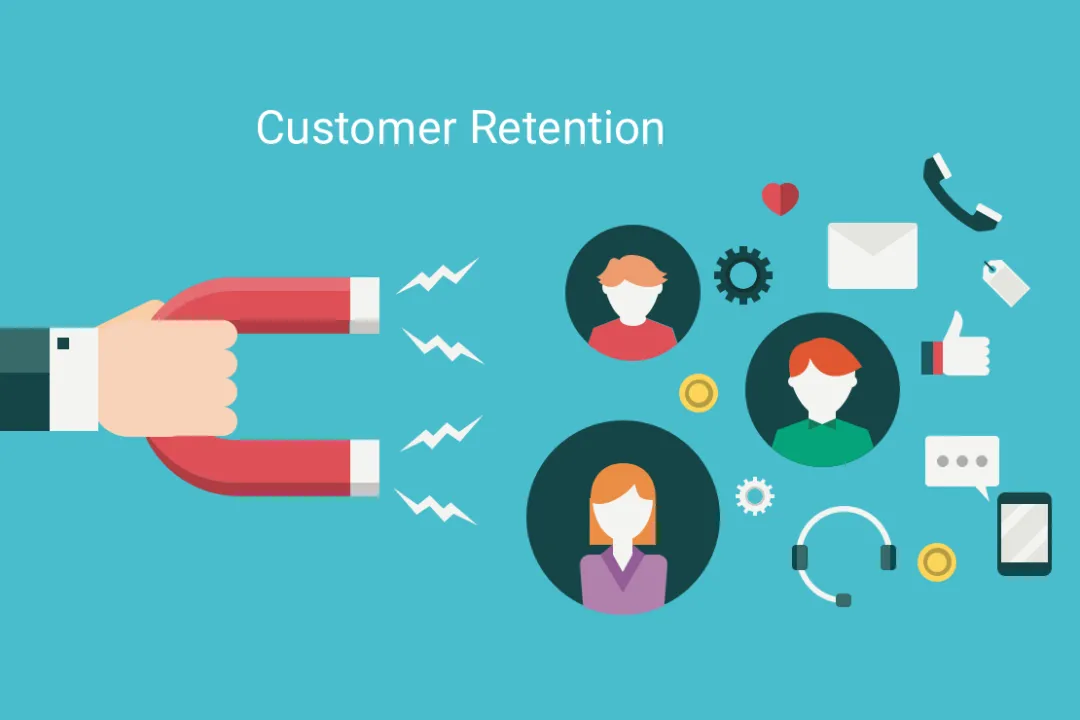
The cost of attracting new customers is rising annually. Competition is increasing, advertising is becoming more expensive, and retaining users’ attention is becoming increasingly difficult. Therefore, companies are increasingly focusing not only on attracting new audiences but also on working with existing customers.
To evaluate the effectiveness of this effort, the Customer Retention Rate (CRR) is used. It shows what percentage of customers continue to use a company’s product or service over a given period.
Research shows that retaining an existing customer is, on average, 4-6 times cheaper for a business than acquiring a new one. Even a small increase in retention can lead to significant revenue growth through repeat purchases and increased customer lifetime value.
What is Customer Retention Rate
Customer Retention Rate (CRR) is an indicator that reflects the proportion of customers who remain engaged with the company over a given period.
A high retention rate typically indicates a high-quality product, excellent service, and effective communication. A declining rate may indicate issues with the customer experience, insufficient product value, or service issues.
CRR is important not only for assessing audience loyalty. It helps plan marketing expenses more accurately, calculate customer acquisition costs, and reduce a business’s dependence on constantly searching for new customers.
In subscription services, high retention rates ensure stable revenue. For online stores, it means increased repeat orders, and in B2B, it means an increase in long-term contracts.
Customer Retention Rate calculation formula
The retention rate is calculated using the formula:
CRR = ((E − N) / S) × 100%
where:
- S — number of clients at the beginning of the period;
- E — number of clients at the end of the period;
- N — number of new clients attracted during this period.
First, new customers are excluded from the total number of customers at the end of the period. The resulting value is then divided by the company’s customer base at the beginning of the period.
Calculation example
Let’s assume:
- at the beginning of the month — 1000 clients;
- new people attracted — 250;
- at the end of the month — 1100 clients.
Calculation:
- retained customers: 1100 − 250 = 850;
- retention rate: 850 / 1000 = 0,85;
- final CRR — 85%.
This means that the company retained 85% of the clients it worked with at the beginning of the month.
How to calculate CRR in different areas
The approach depends on the specifics of the business.
SaaS and subscription services. This metric is typically calculated monthly. A user who renews their subscription or pays for the next period is considered retained.
Online stores. In e-commerce, retention is assessed based on repeat purchases. The analysis period depends on the product category:
- everyday goods — about a month;
- clothing, electronics and other durable goods — from two to six months.
Too short a period may underestimate the indicator, since the customer simply will not have time to make a repeat purchase.
B2B. For the corporate segment, calculations are typically performed quarterly or annually.
A client is considered retained if they have renewed their contract, placed a repeat order, or continue to use the company’s services.
What is considered a good indicator
There’s no single Customer Retention Rate. It depends on your industry and business model.
The average benchmarks are as follows:
- E-commerce — 20–40% per month or 40–60% per year;
- SaaS — 85–95% per month;
- Online media — 70–90%;
- Financial services — more than 90%;
- Mobile apps — about 20–30% of users on day 30.
CRR should only be compared with companies in a similar industry. It’s even more important to monitor your own dynamics: whether the metric is growing, how it changes following product improvements, and which customer segments are retaining the best.
Metrics that are analyzed along with CRR
CRR alone is not enough to fully assess retention.
Additionally used:
- Churn Rate — shows the proportion of clients who terminated cooperation.
- Repeat Purchase Rate — reflects the frequency of repeat purchases.
- Customer Lifetime Value (CLV) — shows the profit a client brings in over the entire period of cooperation.
- Net Promoter Score (NPS) — measures customers’ willingness to recommend a company to others.
A comprehensive analysis of these indicators allows us to more accurately understand the reasons for retention and promptly identify problems.
Strategies to increase Customer Retention Rate
Increasing retention rates cannot be achieved with a single tool. Maximum results are achieved when a company comprehensively addresses product quality, service level, communications, and analytics.
Personalization of communications
A personalized approach significantly increases the likelihood of repeat purchases.
Using data on previous orders, interests, and customer behavior, you can offer the most relevant products and services.
Effective tools are:
- personalized recommendations;
- special offers;
- repeat purchase reminders;
- individual discounts;
- selections of products based on interests.
Such communications are received significantly better than mass mailings and help build long-term loyalty.
Loyalty programs
Bonus programs motivate customers to return again.
The most common mechanics are:
- cumulative discounts;
- bonus points;
- cashback;
- personalized offers;
- privileges for regular customers.
The main rule is that the program should be as clear as possible. If the client has difficulty understanding the terms and conditions for receiving bonuses, the program’s effectiveness is significantly reduced.
Email marketing
Email remains one of the most effective customer retention tools.
Regular communication helps maintain interest in the brand and reminds customers about the company without pushy sales.
Most commonly used:
- product recommendations;
- selections of new products;
- useful articles;
- discount notifications;
- letters after purchase;
- abandoned cart reminders.
The key is to maintain a balance between useful content and commercial offers.
Quality customer service
Even minor service errors can cause a customer to leave.
Fast processing of requests, competent specialists, and convenient communication methods build trust and increase the likelihood of repeat purchases.
In many niches, a high level of service becomes a more significant advantage than a lower price.
CRM systems
CRM allows you to store the entire history of interactions with a client in one place.
With its help you can:
- segment the audience;
- automate communications;
- run retention scripts;
- control repeat sales;
- analyze marketing effectiveness.
Automation significantly simplifies working with the client base and reduces the likelihood of losing customers.
Educational content
Helpful content helps customers get value from a product faster.
These could be:
- instructions;
- articles;
- video tutorials;
- webinars;
- answers to frequently asked questions;
- practical recommendations.
The easier it is for a user to master a product, the higher the likelihood that they will stay with the company for a long time.
Common mistakes in customer retention
Even with a strategy in place, many companies make mistakes that reduce the effectiveness of their customer base.
Ignoring feedback
Customer reviews and inquiries help identify weaknesses in products and services.
If the company does not respond to comments, the client begins to look for an alternative.
Therefore, it is important to regularly analyze feedback and use it to improve the product.
Lack of personalization
The same offers for all audiences are gradually ceasing to work.
It’s much more effective to segment customers by purchase history, interests, and behavior, offering each one the most appropriate solutions.
Insufficient quality of support
Long response times, formulaic messages, and a complex problem-solving process negatively impact customer trust.
To improve the quality of service it is necessary:
- train employees;
- use uniform work standards;
- keep the communication history in CRM.
Complicated return process
If returning a product involves a lot of formalities, the likelihood of a repeat purchase is significantly reduced.
A simple and transparent returns process helps maintain trust even after a negative experience.
Unusable website or app
Even a quality product is difficult to sell through an inconvenient interface.
Most often, clients are scared off by:
- slow page loading;
- complex navigation;
- inconvenient mobile version;
- long order placement process.
Regularly improving the user experience has a positive impact not only on customer retention but also on website conversion.
Customer Retention Rate (CRR) is a key business performance indicator. It helps assess how successfully a company retains customers and builds long-term relationships with their audience.
High retention rates reduce the cost of acquiring new customers, promote repeat sales, and make business growth more stable.
To increase CRR, it is important to use a comprehensive approach: improve service quality, personalize communications, implement CRM systems, develop loyalty programs, and regularly analyze customer behavior.
It’s equally important to track related metrics — churn rate, repeat purchase rate, customer lifetime value (CLV), and net promoter score (NPS). Analyzing these metrics together allows you to more quickly identify problems and make data-driven decisions.
Companies that systematically work to retain customers gain a more loyal audience, increase profits, and reduce their dependence on constantly growing advertising budgets.